Airless Sprayers for Roof Coating
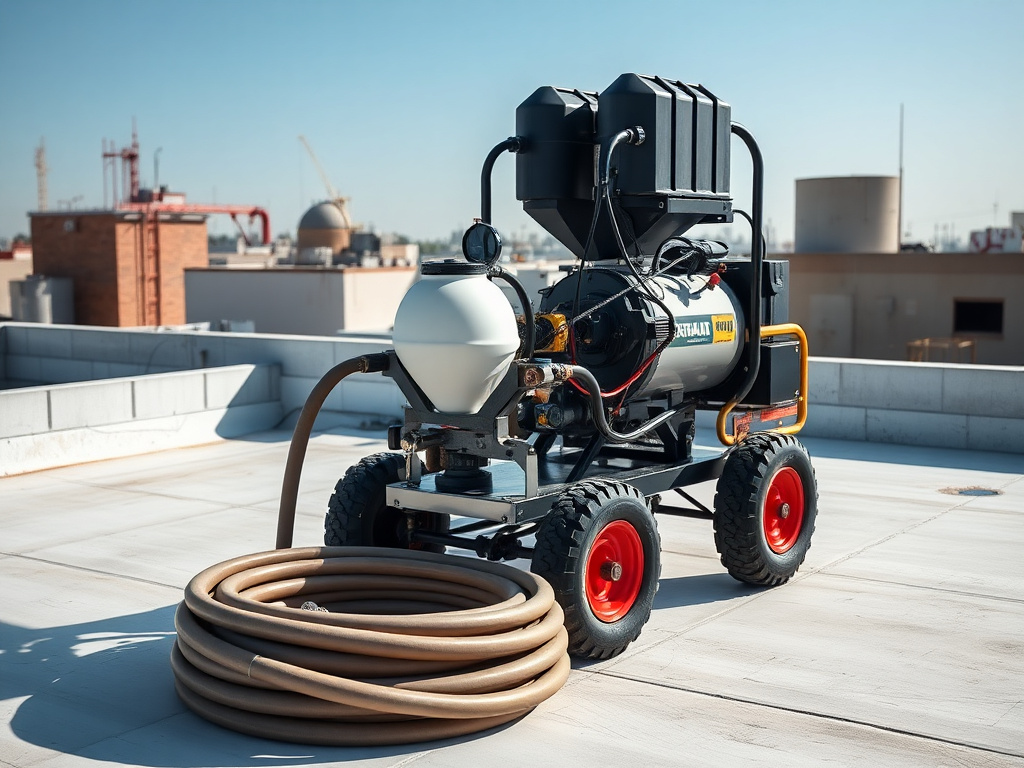
Airless sprayers force coating through a small tip orifice at high pressure, with no compressed air added at the nozzle — atomization happens purely from the pressure drop as material exits the tip. This is the standard equipment category for any single-component roof coating: acrylic, elastomeric, and most silicone systems that ship pre-mixed and ready to spray.
Within "airless," the pump architecture is the real dividing line. Diaphragm pumps and piston pumps handle roof-coating viscosities very differently, and picking the wrong one for the job is the most common equipment-fit mistake contractors run into.
Why it works this way
- No compressed air system to haul, maintain, or feed — pressure comes entirely from the pump
- Higher build rates per pass than air-assisted spraying, which matters on large flat and low-slope commercial roofs
- Widely available in both diaphragm and piston architectures, so output can be matched to job size
- Standard tip interchangeability lets one rig cover a range of coating viscosities by swapping tips
Ideal for
- Single-component acrylic and elastomeric roof coatings
- Most silicone roof coatings, provided the pump can hit the pressure the product's spray guide calls for
- Contractors who don't need plural-component metering for 2-part or foam systems
Diaphragm pumps
Diaphragm pumps run at a lower pressure ceiling than piston pumps, deliver smoother, less pulsation-prone flow, and generally have fewer wear parts in direct contact with material — the main service item is the diaphragm itself, which tends to be simpler and cheaper to replace than a piston-and-cylinder set.
That lower pressure ceiling is the tradeoff: diaphragm units are typically not built to push very thick, high-solids coating at volume. They're a strong fit for smaller-to-medium jobs, shorter hose runs, and situations where portability and lower maintenance overhead matter more than maximum output.
- Lower operating pressure than piston pumps
- Smoother, more pulsation-free flow
- Simpler, generally lower-cost wear-part replacement
- Better fit for lighter coatings, smaller jobs, shorter hose runs
Piston pumps
Piston pumps are capable of materially higher pressures — often cited in the 3,000 PSI-and-up range — which is the category most roof coating contractors need once they're working with higher-viscosity silicone products, long hose runs up onto a roof, or multi-gun setups on larger commercial jobs.
For sustained high-build work across large flat-roof coating projects, a piston pump is generally the better-suited architecture. The higher pressure ceiling gives more headroom to keep atomization quality consistent as hose length, elevation, and material viscosity all work against pressure at the gun.
- Materially higher pressure ceiling, often cited at 3,000+ PSI and up
- Better suited to high-viscosity coatings and long hose runs
- Handles multi-gun commercial setups more capably
- Generally the right category for sustained high-build roof work
Silicone needs more than a standard airless setup
Silicone roof coatings run noticeably higher viscosity than acrylics, and manufacturer spray guides reflect that: published guidance for high-solids silicone coatings has called for pressures in the 5,000–7,000 PSI range with roughly 4 GPM output, or alternatively a minimum around 3,500 PSI at the gun fed by a 5:1 transfer pump to prevent the main pump from cavitating on thick material.
This is well beyond what a standard direct-drive or diaphragm airless unit is built for — silicone work generally requires a hydraulic piston pump, and coating manufacturers' own spray guides are the authoritative source for the exact pressure, tip, and fan-angle spec for a given product. Material temperature matters too: silicone should generally be kept at a minimum around 65°F to stay sprayable; colder material thickens and atomizes poorly.
Typical ranges
Typical ranges — always confirm against the specific coating's technical data sheet (TDS) before spraying.
| Typical pressure range | Varies by pump class — diaphragm units run lower; hydraulic piston units used for silicone are commonly spec'd in the 3,500–7,000 PSI range depending on the product |
| Coating types supported | Acrylic, elastomeric, most silicone (single-component, pre-mixed products) |
| Hose | Standard high-pressure airless hose; length and diameter sized to job and pressure loss over the run |
| Cleanup | Water flush for water-based acrylics; silicone typically needs a manufacturer-specified thinner/cleaner, not a straight water flush |
Airless Sprayers FAQs
Only if it's a hydraulic piston unit capable of the pressure the coating's spray guide calls for — published silicone spray guides have specified pressures as high as 5,000–7,000 PSI with roughly 4 GPM output. A standard direct-drive or diaphragm unit built for wall paint or light acrylic work generally won't have the pressure headroom silicone needs.
It depends on coating viscosity, job size, and hose run length. Diaphragm pumps suit lighter coatings, smaller jobs, and shorter runs where lower maintenance and smoother flow matter most. Piston pumps handle higher-viscosity coatings, longer runs, and multi-gun commercial setups — and are generally the pump architecture manufacturers spec for silicone.
Compare the other equipment category
Get personalized equipment buying help
Tell us about your coating type, job size, and current setup — we'll point you toward the equipment category and specs that actually fit, no brand pitch attached.