Airless vs Plural-Component: Which Sprayer Does Your Roof Coating Job Actually Need?
Contractors often frame this as a budget question. It isn't — it's a chemistry question. Here's how to tell which equipment category your job actually requires.
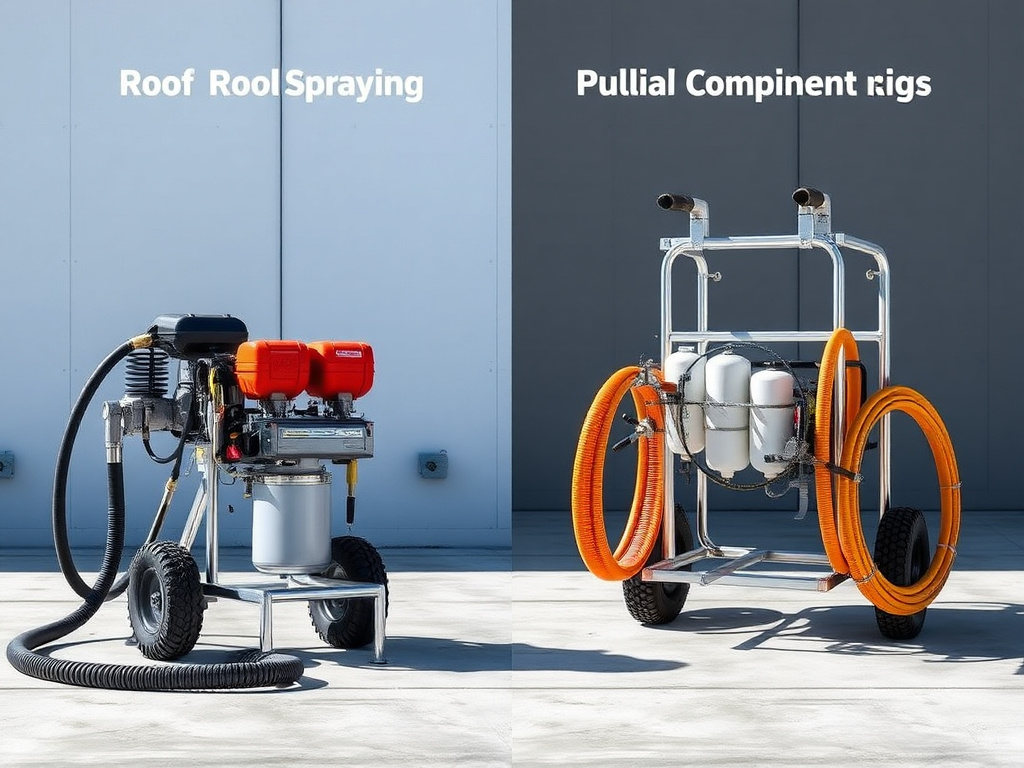
Start with the coating, not the budget
It's tempting to treat airless vs plural-component as an upgrade path — buy the cheaper airless rig first, step up to plural-component later once the business grows. That framing misses the actual decision driver: it's not about job size or budget tier, it's about whether the coating you're spraying is single-component or a reactive two-part system.
Acrylic, elastomeric, and most silicone roof coatings ship pre-mixed and ready to spray. They're single-component products, and a sufficiently high-pressure airless sprayer — diaphragm for lighter work, hydraulic piston for silicone-class viscosity — is the correct equipment category, full stop. No amount of job growth changes that; a bigger roof just means a bigger airless pump, not a different equipment category.
Where plural-component becomes non-negotiable
Spray polyurethane foam (SPF) roofing and true two-part coatings — polyurea, certain 2-part polyurethane topcoats — are chemically reactive systems. The A-side and B-side have to be metered at the correct ratio, heated to the right temperature, and mixed only at the gun tip. An airless sprayer physically cannot do this; there's no mechanism to keep two separate components apart until the point of application, let alone heat and proportion them correctly.
If any part of your workflow involves spraying SPF as a roof substrate, plural-component equipment with heated hose isn't a nicer option — it's the only equipment architecture that works. There's no airless workaround.
The common combined workflow
A lot of roofing contractors end up needing both equipment categories, not because they're hedging, but because the job itself has two chemically different steps: SPF foam goes down as the roof substrate (plural-component), then an elastomeric or silicone coating goes over it as the topcoat (airless). That's a standard SPF-roofing workflow, not a sign of over-buying equipment.
If your work is coating-only — recoating an existing roof, no foam substrate involved — you likely only need the airless side of that equation, sized to the coating's viscosity.
A simple way to check
Look at the coating's technical data sheet. If it lists a single mix ratio of zero — i.e., it's supplied ready-to-spray with no field mixing of reactive components — you're in airless territory. If the TDS specifies an A-side and B-side, a mix ratio, and a pot life or gel time, you're looking at a plural-component product, and airless equipment is not an option regardless of how the pump is sized.
Related FAQs
Generally no — silicone and acrylic roof coatings are almost always single-component, pre-mixed products designed for airless application. Plural-component equipment is built around proportioning two reactive components, which isn't how these coatings are formulated.
Get personalized equipment buying help
Tell us about your coating type, job size, and current setup — we'll point you toward the equipment category and specs that actually fit, no brand pitch attached.